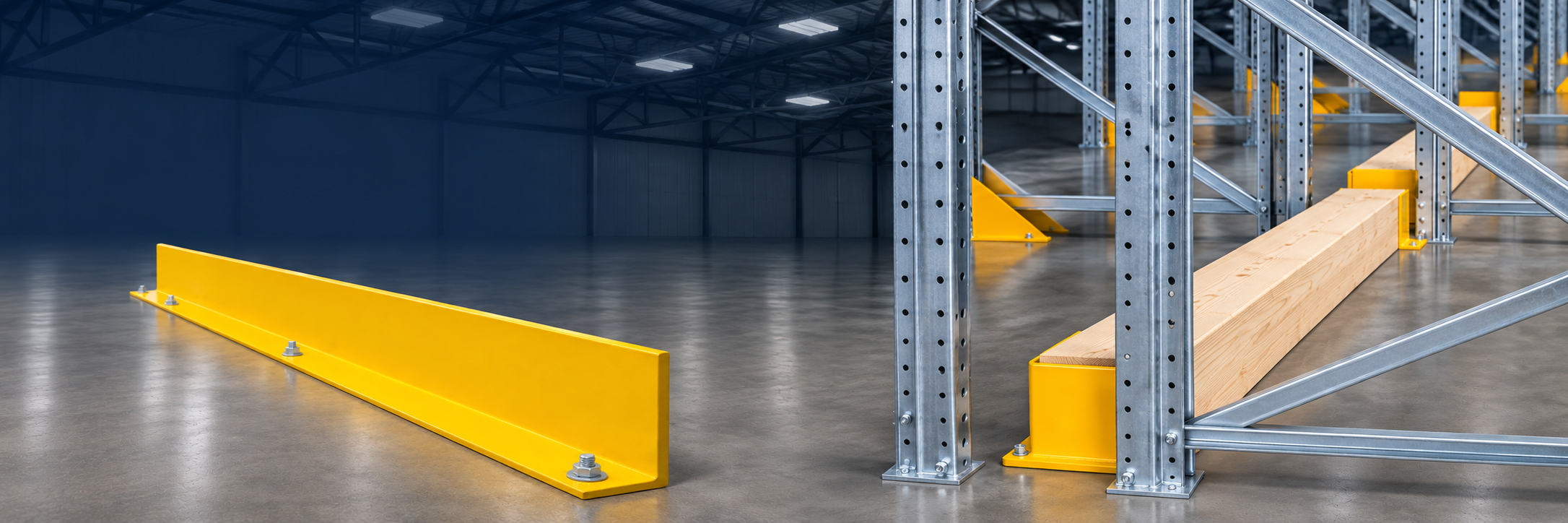
Pallet backstops and floor stops protecting a warehouse

Supply & Installation

Pallet Backstops & Warehouse Floor Stops

Protect Your Racking. Protect Your Building. Control Unwanted Pallet Movement.

Practical Protection for Warehouses and Distribution Centres

Accidental pallet movement and vehicle impacts can cause significant damage to warehouse infrastructure, including pallet racking, pedestrian walkways, partition walls, insulated cold-store panels and equipment.

At True Space Solutions, we supply and install a range of pallet backstops, floor-mounted steel stops and vehicle guidance systems designed to help manage these risks.

Not all backstops perform the same function.

Some prevent pallets moving beyond designated storage positions. Others protect buildings and vulnerable structures or help guide mechanical handling equipment during loading and unloading.

Our approach is to understand the storage application, identify the risks and recommend the right protection.

Discuss Your Pallet Backstop Requirements

Our Six Pallet Backstop Solutions

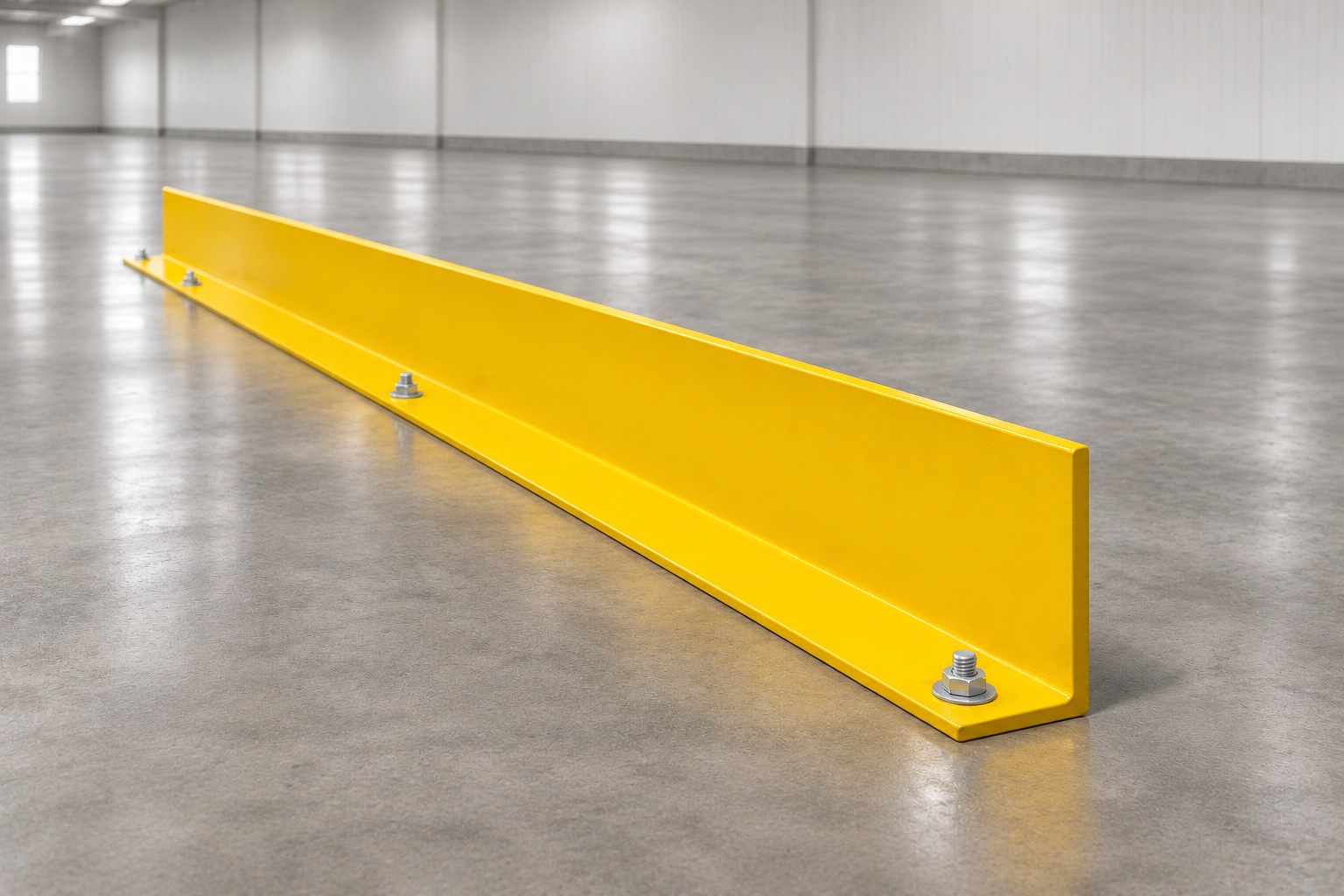
Floor-mounted steel angle backstop protecting a warehouse wall

1. Floor-Mounted Steel Angle Backstops

Protecting pedestrian walkways, partition walls and vulnerable structures.

Floor-mounted steel angles provide a robust physical stop to help prevent ground-level pallets being pushed beyond their intended storage positions.

These are particularly useful where ground-level pallet storage is positioned alongside:

  • Pedestrian walkways.
  • Internal warehouse partition walls.
  • Insulated cold-store and chilled warehouse panels.
  • Building walls and structural features.
  • Vulnerable equipment and services.
  • Designated access routes.

Independently floor-mounted steel stops can be designed to transfer anticipated forces into a suitable concrete floor slab rather than directly into the pallet racking.

The required steel section, height, positioning and anchorage must be selected for the potential loads and operational conditions.

Where forklift impact is foreseeable, additional engineered vehicle protection may be required.

Ideal for: Preventing ground-level pallets being pushed into walkways, walls and vulnerable building structures.
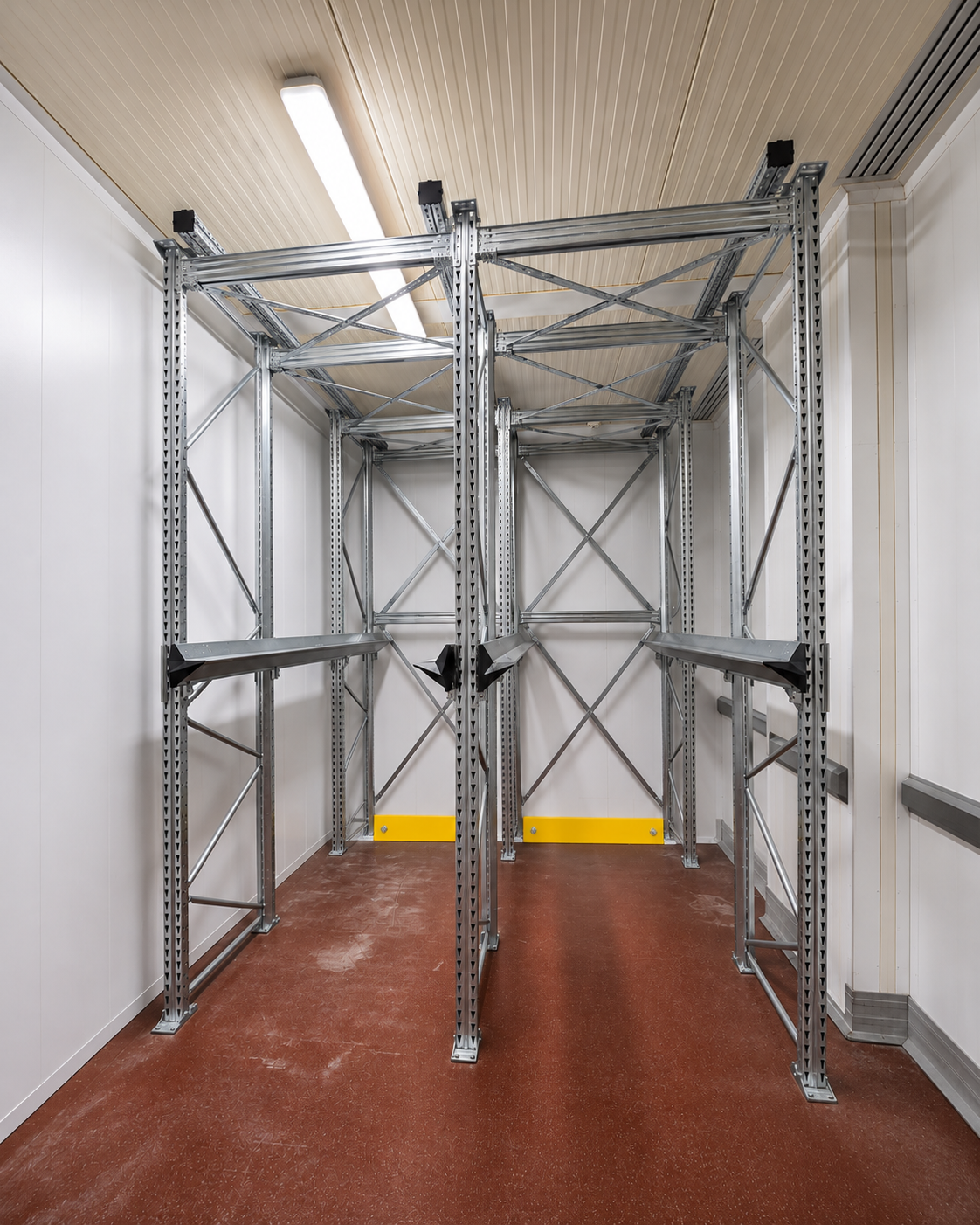
Steel angle stop at the rear of a drive-in racking pallet lane

2. Steel Angle Stops for Drive-In Racking

Helping protect the rear of drive-in storage lanes.

Drive-in racking provides high-density pallet storage but requires careful pallet handling within deep storage lanes.

Floor-mounted steel angle stops may be fitted at the rear of suitable ground-level lanes to help prevent pallets being pushed beyond the intended storage boundary.

Potential benefits include:

  • Restricting accidental rearward pallet movement.
  • Protecting structures behind the storage lanes.
  • Providing a physical stop at floor level.
  • Reducing reliance on the rack structure to resist accidental ground-level pallet movement.

The design must be compatible with the drive-in racking manufacturer's requirements.

It must not obstruct normal forklift operation or create additional handling risks.

Ideal for: Ground-level protection in drive-in storage lanes.

Triangular steel guide rails fixed to a warehouse floor

3. Floor-Mounted Toblerone Steel Guides

Helping protect racking during loading and unloading of live storage stystems.

Toblerone guides are heavy-duty steel angle sections installed at floor level to warn MHE on the permissible distance from the racking structure.

They are particularly useful for gravity-flow pallet racking and 1D shuttle systems, where forklifts repeatedly approach loading and unloading locations.

Correctly specified guides can help reduce the likelihood of forklifts straying into vulnerable racking components.

Typical applications include:

  • Gravity pallet racking loading stations.
  • Gravity racking unloading positions.
  • Repetitive forklift approach lanes.
  • Areas where trucks operate close to racking uprights.
  • Specialist material handling layouts.

The steel angles can be fabricated in different lengths and sections  dependent on the type of MHE and are secured with suitably designed floor fixings.

High-visibility finishes.

The guides must be compatible with the forklift design, wheel arrangements, operating clearances and anticipated contact forces.

Important: Guidance angles should not automatically be treated as impact-rated vehicle barriers.

Ideal for: Busy gravity and 1 D shuttle racking applications where accurate forklift positioning can help prevent contact with the racking.

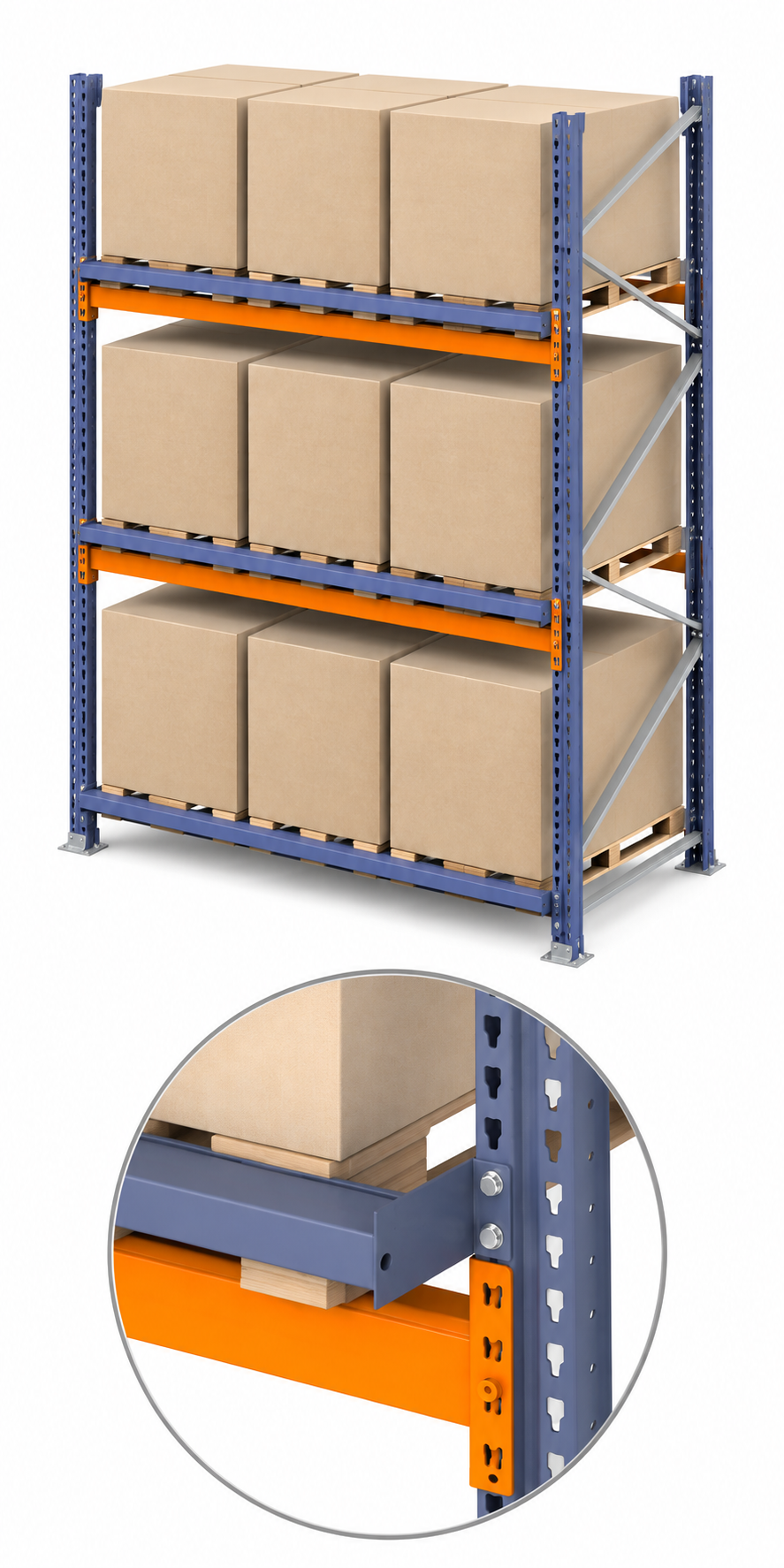
Pallet backstop beam fitted within warehouse racking

4. Pallet Backstop Beams

Rack-mounted products requiring careful consideration.

Pallet backstop beams are horizontal steel components installed behind pallet storage positions.

They are intended to help restrict excessive pallet movement beyond the rear of a storage location.

However, HSG76 paragraph 635 warns that pallet stops attached to racking may introduce additional forces and increase the risk of structural damage.

For this reason, True Space Solutions does not promote rack-mounted backstop beams as a routine pallet positioning aid.

We recognise that some customers have specific requirements for these products.

Where backstop beams are requested, we can help review the proposed application and consult the racking manufacturer or competent designer.

Important considerations include:

  • The intended function of the stop.
  • Whether contact is accidental or routine.
  • Horizontal loads transferred into the racking.
  • Beam and upright capacity.
  • Racking manufacturer approval.
  • Pallet clearances and flue spaces.
  • The effects of retrofitting onto an existing installation.

Our approach: Where rack-mounted backstop beams are requested, the proposed arrangement should be technically assessed and approved rather than simply installed as an accessory.

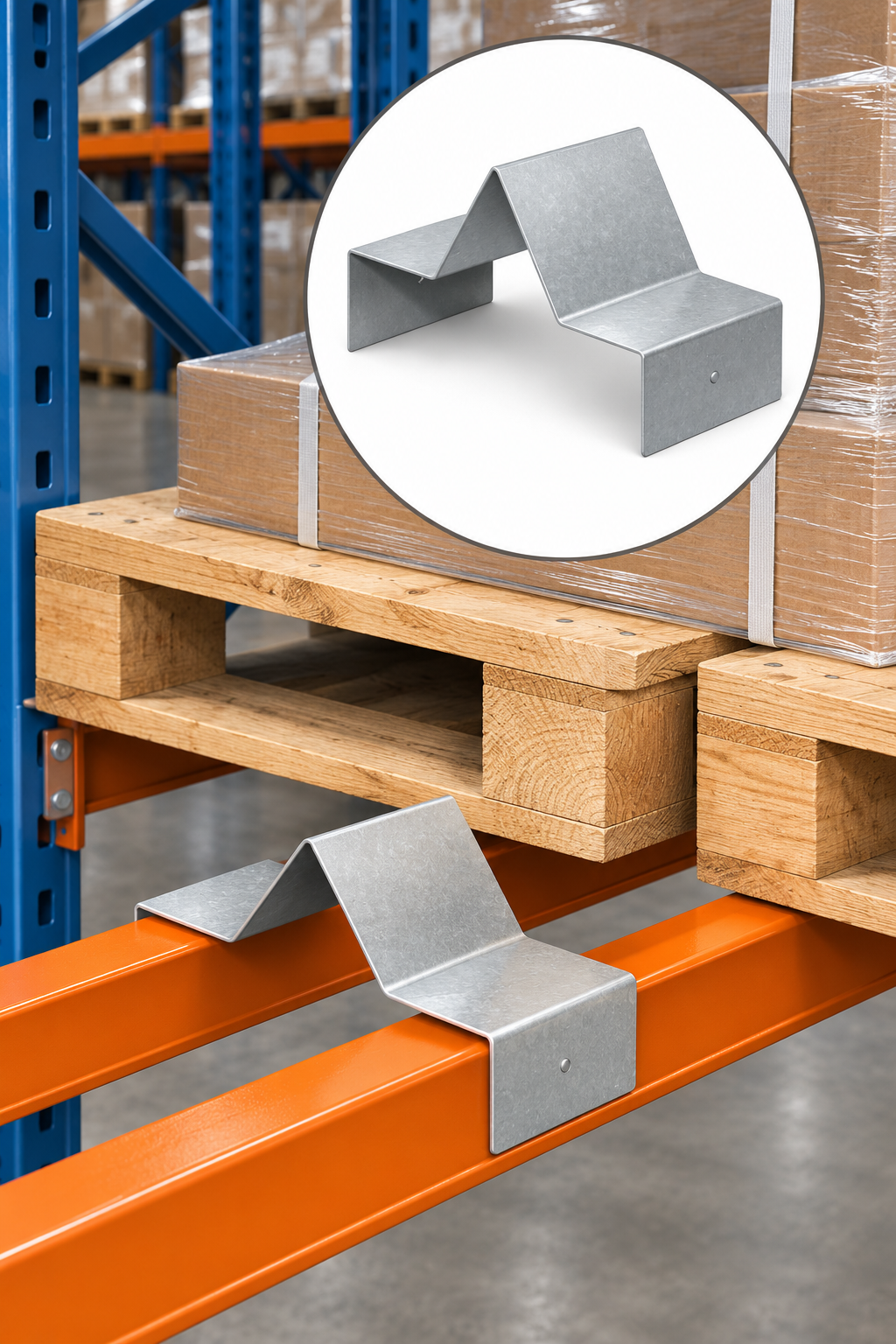
Compact individual pallet safety stop in a racking bay

5. Individual Pallet Safety Stops & Flue Protectors

Compact protection for selected pallet locations.

Individual pallet safety stops are compact metal accessories fitted at selected storage positions.

Products similar to WorldStop pallet safety stops are designed to help control rear pallet movement and maintain specified gaps between stored loads.

These may be available in single or double arrangements for different racking configurations.

Potential applications include:

  • Individual pallet storage locations.
  • Back-to-back pallet racking.
  • Areas where specified flue spaces need to be maintained.
  • Selected locations requiring additional protection against accidental pallet push-through.

These products are not universally compatible with all racking systems.

Because the stops may transfer loads into beams or other components, their compatibility and structural effect must be established before installation.

Where maintaining fire protection flue spaces is a consideration, the actual clearance requirements must be confirmed with the relevant sprinkler or fire protection designer.

Do not apply United States fire-code dimensions automatically to UK warehouse installations.

Product example for reference:

WorldStop Pallet Safety Stop (external product example)

Use this as an example of the product style, not evidence that the exact product is approved for UK use.

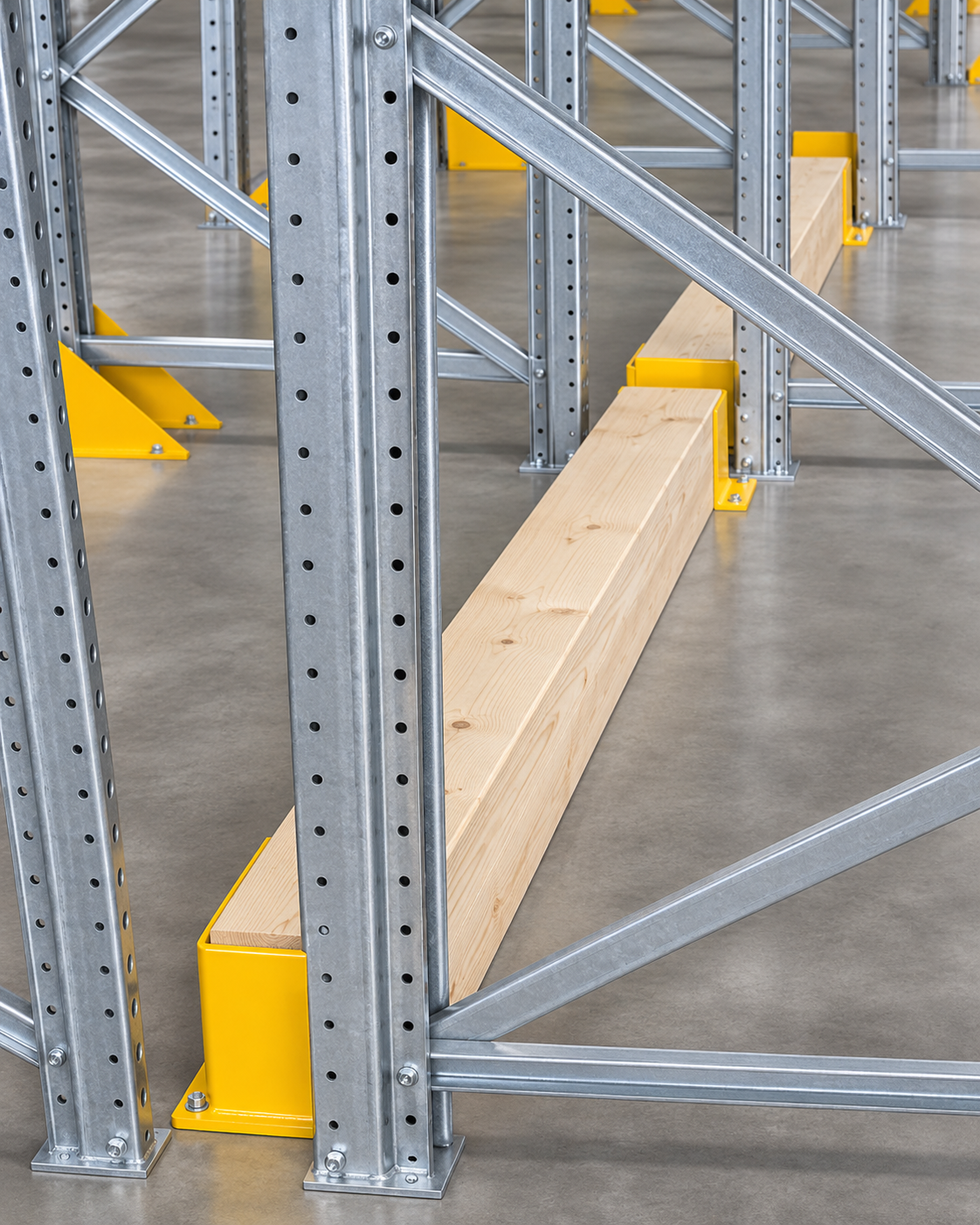
Heavy-duty timber backstop at floor level in a warehouse

6. Heavy-Duty Timber Pallet Backstops

Bespoke ground-level protection for selected warehouse applications.

Heavy-duty timber backstops provide another possible option for restricting movement of ground-level pallets.

These may comprise substantial timber sections supported and fixed through a suitably designed floor or independent support arrangement.

Potential applications include:

  • Ground-level pallet storage.
  • Storage positions within or adjacent to back-to-back racking runs.
  • Locations where rearward pallet movement must be controlled.
  • Bespoke floor-level pallet protection arrangements.

These systems may be particularly useful where a continuous physical stop is required over several pallet positions.

However, the suitability depends on:

  • Timber grade and section size.
  • Fixing and support arrangements.
  • Expected pallet loads.
  • Potential impact forces.
  • Floor condition and anchorage.
  • Moisture, hygiene and environmental conditions.

Important: A timber backstop must not automatically be assumed capable of containing a moving forklift or resisting significant pallet impact.

Why Floor-Mounted Backstops Can Be an Effective Solution

Protect the Building Without Unnecessarily Loading the Racking

The key distinction between rack-mounted and independently floor-mounted pallet stops is where the applied forces are transferred.

A stop connected directly to pallet racking may transmit unexpected horizontal forces into beams, uprights and bracing.

An independently floor-mounted solution can instead be engineered to transfer the intended loads into a suitable floor slab.

This may be beneficial when protecting:

  • Pedestrian walkways.
  • Partition walls.
  • Cold-store panels.
  • Building infrastructure.
  • Storage and handling equipment.

However, a floor-mounted stop is not automatically an impact-rated barrier. Its design and fixings must be suitable for the forces it may experience.

What Does HSG76 Say About Pallet Backstops?

HSG76 – Paragraph 635

This is the main reference for pallet stops. It warns that stops attached to racking can increase the risk of structural damage because of the forces applied during pallet handling. It also explains that suitable racking layouts, adequate clearances and competent operators should normally enable safe pallet positioning without relying on stops.

HSG76 – Paragraph 556

Identifies goods being pushed through the rear of racking as a recognised falling-object hazard.

HSG76 – Paragraph 557

Addresses the need to prevent unauthorised access to areas where people could be struck by falling objects.

HSG76 – Paragraphs 639–640

Discuss protection of pallet racking from vehicle impacts and the importance of maintaining suitable MHE operating clearances.

HSG76 – Warehousing and Storage: A Guide to Health and Safety (HSE)

FEM and Industry Guidance on Pallet Backstops

FEM Racking and Shelving Information Bulletin No. 11 distinguishes between two types of backstop.

Safety Backstops

Designed for accidental contact rather than regular pallet positioning. Such stops should not be used as a routine placement aid and should be designed so the rack structure is not damaged by the anticipated event.

Buffering Backstops

Designed to accommodate specified pallet-positioning forces. Where buffering stops are used, the complete racking structure and associated floor fixings must be designed for the resulting loads.

This distinction is particularly important when assessing rack-mounted backstop beams and individual pallet stop products.

FEM Racking and Shelving Information Bulletin No. 11 – Backstops

HSE – Protecting Warehouse Structures

HSE workplace transport guidance identifies building walls, partitions, columns and other permanent features as potential hazards where collisions may occur.

The guidance recommends considering the weight, speed and angle of vehicle impacts, alongside the consequences of damage.

Floor-mounted backstops can be considered as one potential protective measure where suitable for the application.

HSE – Workplace Transport: Protecting People and Property

Correct Specification Is Essential

Before recommending a backstop, True Space Solutions considers:

Storage application

What is being stored and how pallets are handled.

Pallet dimensions and weight

Including the forces likely to arise from accidental movement.

MHE type

Forklift dimensions, travel direction and operating characteristics.

Vulnerable areas

Pedestrian routes, partition walls, cold-store panels, equipment and adjacent storage.

Supporting structure

Whether the protection is independently floor-mounted or connected to racking.

Floor condition

Slab thickness, joints, concrete condition and anchor suitability.

Operating clearances

Ensuring the stop does not restrict safe movements.

Environmental conditions

Temperature, moisture, corrosion and hygiene.

Our objective is to specify a solution based on the actual risk rather than simply supplying a standard product.

Why Choose True Space Solutions?

Through our expertise in pallet racking inspections, repairs, installations and reconfigurations, we understand the consequences of incorrect pallet positioning and unsuitable warehouse protection.

We can help customers:

  • Identify vulnerable areas.
  • Review ground-level pallet storage arrangements.
  • Assess requirements for floor-mounted protection.
  • Coordinate bespoke steel fabrication.
  • Investigate rack-mounted systems where specifically requested.
  • Supply and install suitable protection.
  • Arrange specialist design input where required.

We understand that an incorrectly specified backstop can introduce new risks rather than resolve existing ones.

Frequently Asked Questions

The Right Backstop Starts with Understanding What You're Trying to Protect

Whether you need floor-mounted steel angles, guidance for gravity racking, a specialist pallet stop or bespoke timber protection, True Space Solutions can help.

Service you expect. People you trust.